


Table of Contents
Richards-Wilcox: American Garage Door Manufacturer Since 1912
Richards-Wilcox is a American Manufacturer of garage doors for both commercial and domestic properties. They have a premium brand that they have been growing since start of production in 1912 so with over 100 years of manufacturing experience it was an honour to work with the team.

Richards-Wilcox first approached our Chicago based team to discuss improving adhesion of foam on to metal. When building their insulated door range a polyurethane foam injected between two steel sheets which make up the sections of the doors.
Liquid foam adhesion is a common reason to prepare and treat materials to improve initial wetting and flow of the polyurethane material in the first place, allowing the liquid to flow through the cavity quicker and displace any trapped air easier which immediately gives a jump in performance and repeatability.
The treatment then also improves adhesion of the foam, allowing it to be securely bonded within and be much more resilient to temperature changes which causes expansion and contraction of the metal panels. For products like this it is important to consider this over the lifetime of the product because they will be subjected to intense heat and sun in summer months and freezing winds and ice in winter months.
Investigating Corona Treatment
Deciding to reach out to Tantec, the Richards-Wilcox team invited Sales Engineer Scott Beatty who visited the site to discuss the problems, the technology and run small scale trials.
This is a sensible approach for many applications because treatment on small parts is usually very quick and easily done and while it might not show the finished product, it gives us a clear answer on whether treatment gives the performance required by the customer, or is the problem elsewhere. We can find that while adhesion improvement is important, it might also be the type of foam or processing that has a big impact too.

This simple approach gave the team confidence to move ahead with their order and design a machine that would fit their production environment.
Possible Solutions For Large Area Treatment Of Metal Sheets
Surface treatment of large parts can be tricky, especially to work inline with other manufacturing processes and be sensibly priced.
There are a few options such as vacuum plasma or single plasma nozzles which might seem sensible at first glance, but often get discounted as discussions move forward.
Vacuum Plasma Sheet Treatment
Vacuum Plasma works by placing the entire part within a chamber and taking the pressure to roughly 1/1000th of normal atmosphere, the system then creates plasma with the little gas remaining.

These systems can be very costly when large sizes are needed and they are always batch or indexing batch so don’t work well for large sheets, although technically the treatment is efficient and powerful so would work well.
It is more common to see vacuum plasma of smaller sheets because the flexibility of such as system means that any part can be placed in the chamber without the need for parameter changes, tooling or jigs.
Vacuum plasma has worked well for customers looking to treat small and relatively flat moulded components such as key pads, cases and trays before and quick and simple removable trays are often a great way to do this while keeping the machine running as much as possible rather than having time wasted with loading and unloading.
Atmospheric Plasma Sheet Treatment
Atmospheric Plasma has a few options starting from intense, high speed (up to 100m/min+) single nozzles to larger area treatment systems that usually run less than 10m/min.
Single nozzles treat roughly 10mm to 15mm so treating a whole 4ft x 8ft sheet or any other large size means moving the head back and forward a lot of times, or installing a lot of nozzles. Both those options are possible but they weren’t the best solution in this case.
Wider treatment using the SpinTEC range is a sensible option, especially if the line already has a moving conveyor proceeding at slow speed so that the head can move across.
SpinTEC ranges from 30mm treatment up to 150mm treatment so makes it much more sensible for covering large areas quickly, especially with multiple heads. Because these systems are based on plasma technology they are much more flexible and can be bolted on to an existing line much easier than installing the more engineered solutions such as corona treatment.

While this option is sensible for sheets and large flat parts, on this occasion it didn’t quite make it as the final solution for the problem.
Corona Treatment of Sheets
While both vacuum plasma and atmospheric plasma can be sensible for treating sheets, there is usually an undisputed winner for such a project; corona treatment can treat narrow foams, boards or sheets and can also treat wide materials, many systems treating 2m and wider parts with ease.
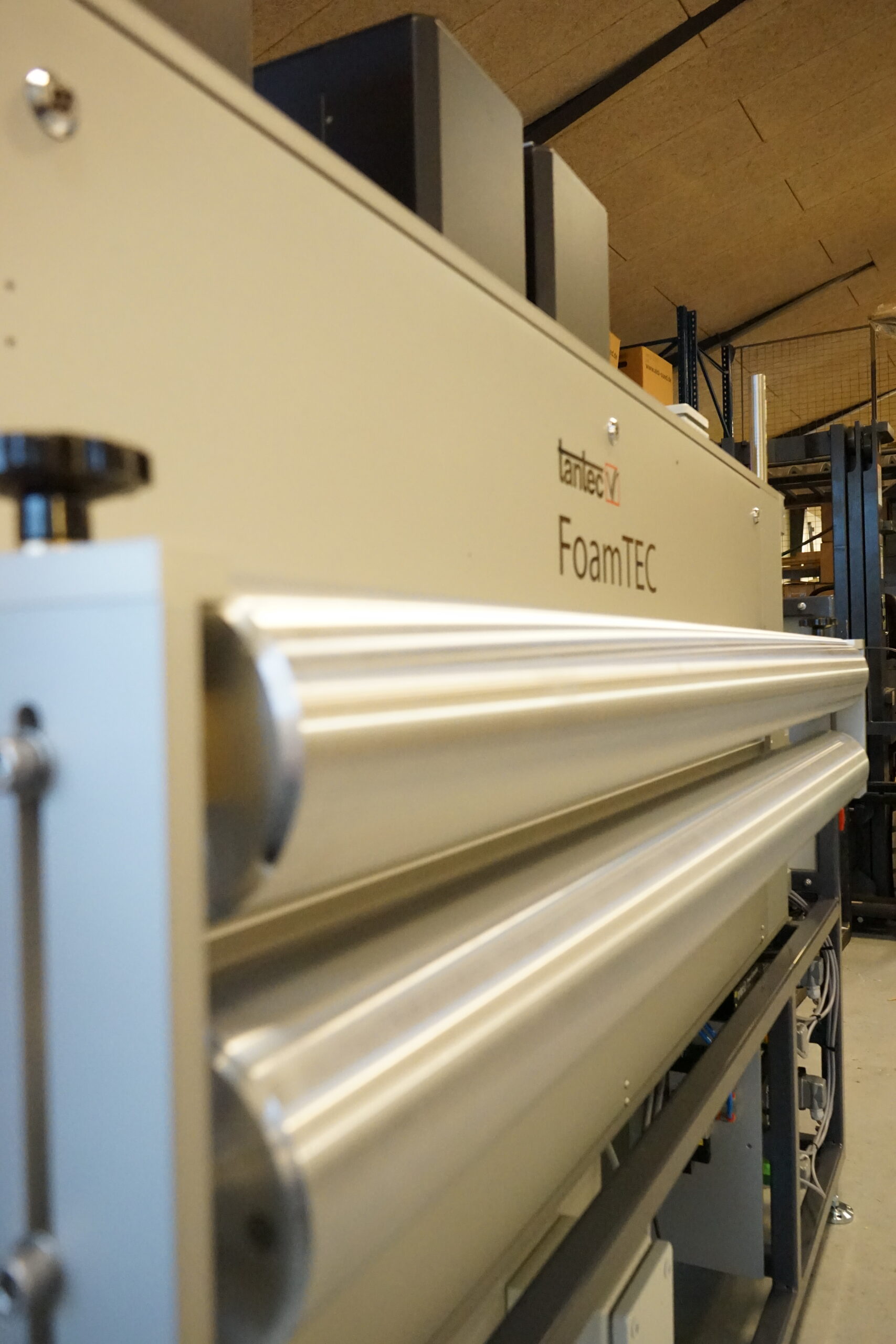
With the other systems, everything tends to get bigger or need more heads which can make the investment not rewarding enough. Corona treatment obviously gets bigger to treat larger parts, but a large system isn’t especially more complex and adding more power which is the key component for treatment is relatively easy.
With the other systems, everything tends to get bigger or need more heads which can make the investment not rewarding enough. Corona treatment obviously gets bigger to treat larger parts, but a large system isn’t especially more complex and adding more power which is the key component for treatment is relatively easy.
Corona treatment is perfect for sheets, foams or board treatment and for direct inline integration or as a standalone system with it’s own conveyor or part moving.
The Solution
Tantec have a number of available design concepts for sheet treating and none more obvious than the SheetTEC Corona Treatment system.
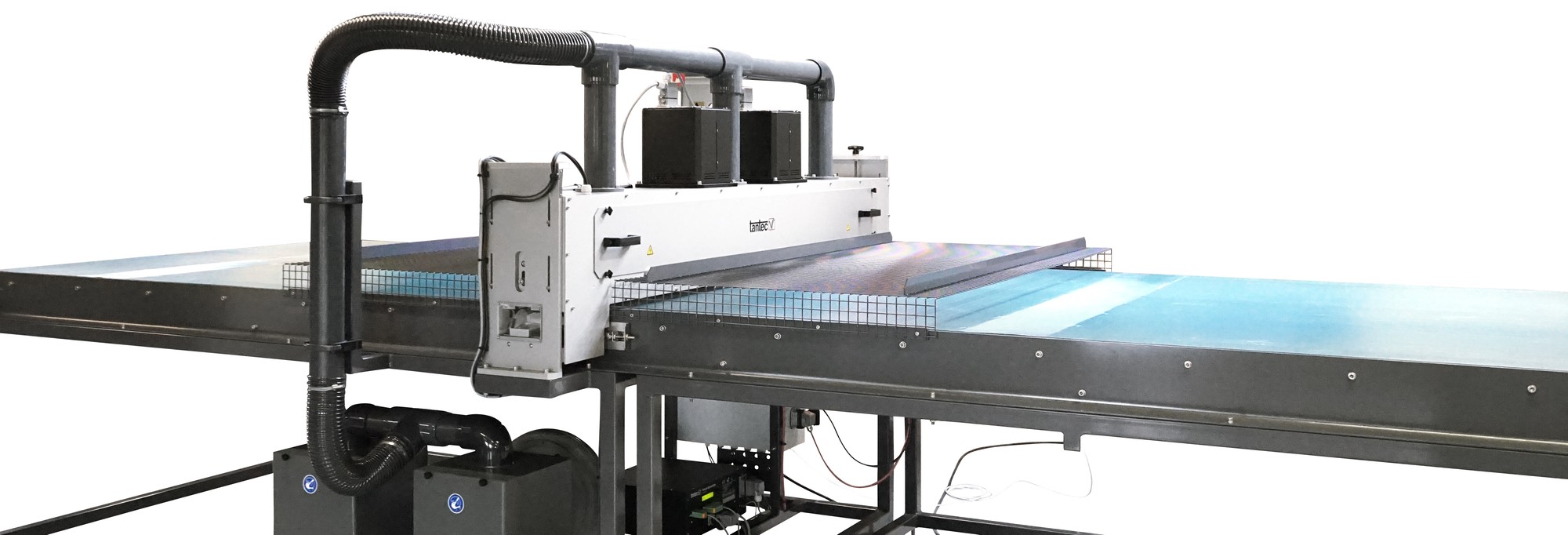
The SheetTEC design can accommodate flat materials in either conductive or nonconductive form and is usually designed for materials up to 5mm thick and usually up to 2m wide although much wider have been done for more specialist applications.
For thicker materials, variable conductivity or materials with variable structure like foams, the FoamTEC system tends to take over.
Corona systems like SheetTEC are available in a couple of different versions, the usual big differences being whether the machine is a bolt on addition to an existing production line, whether it’s a wheel in turn key system for a production line or a standalone machine designed for parts to be presented by an operator.
Corona systems like SheetTEC are available in a couple of different versions, the usual big differences being whether the machine is a bolt on addition to an existing production line, whether it’s a wheel in turn key system for a production line or a standalone machine designed for parts to be presented by an operator.

In this case Richards-Wilcox went for an inline treatment system to meet production demand which has been installed on multiple production lines.
A Great Collaboration
Throughout the process, Richards-Wilcox were impressed with the service from Tantec. From initial discussions and trials with Scott in the US office, to drawing and manufacturing updates from the Danish factory.
Director of Operations, Drew Kumar comments:
“We placed the order with Tantec to get two units for our two lines. Install happened right then and there when they arrived, and now they are running full time. So far, we haven’t had any real issues, and our test results show increased adhesion.”
Shipping and delivery of a complex machine for installation into an existing line can have headaches and there were a few small hiccups on getting the machine in an working 100%.
“When the install was going on, we had a couple of minor issues. But again, the Danish office was great. I have zero complaints around it […] they were super responsive in trying to resolve the issues, sending us replacement parts very quickly“
Richards Wilcox soon found that their newly installed equipment was straightforward to operate. At Tantec, we’re proud and happy that implementation has been such a success. Scott Beatty at the US office adds:
“Working with the people at Richards Wilcox has been nothing but great. They have been super professional and knowledgeable from the get-go, so I’m not surprised their production line easily benefits from the corona treatment technology.”


