


Table of Contents
An Introduction to Atmospheric Plasma
Atmospheric plasma, also known as jet plasma, open air plasma, plasma nozzles and even plasma flame is a pretreatment process designed to prime and prepare a surface to improve surface energy and adhesion.
Working as a jet of plasma, it is highly targeted and perfect for treating local areas or installing on a moving line as a passive treatment. We’ll take a quick look at some of the typical applications and systems to explain some of the common ways manufacturers use this technology.
What Does Plasma Do?
For more information on what is plasma in general, and what does it do the a material, see our other blogs dedicated to this for more in depth descriptions. But as quick overview, plasma is an energetic gas which is created by applying high voltage to air in most cases. This highly energetic gas interacts with the material surface to give it new chemistry and useful surface energy that’s perfect for liquids to wet the surface as well as improving adhesion of coatings, inks or adhesives.
While we talk about Atmospheric Plasma here, this is very similar technology to both corona treatment and vacuum plasma treatment.
How Does Plasma Work?
The simplest way to understand how Atmospheric Plasma nozzles work is to take a look at one…

A typical plasma system will have three common components:
- Generator
- The heart and brains of the machine, this is where the control of the plasma takes place which means taking incoming mains power and stepping up the voltage high enough to create a plasma as well as controlling air flow, frequency and handling incoming and outgoing signals.
- Control Panel
- In the photo above, the control is a simple HMI which has several options for changing parameters and observing live information, but this is often replaced with simple cable connections with inputs and outputs controlled through a PLC or other control unit.
- Nozzle Head
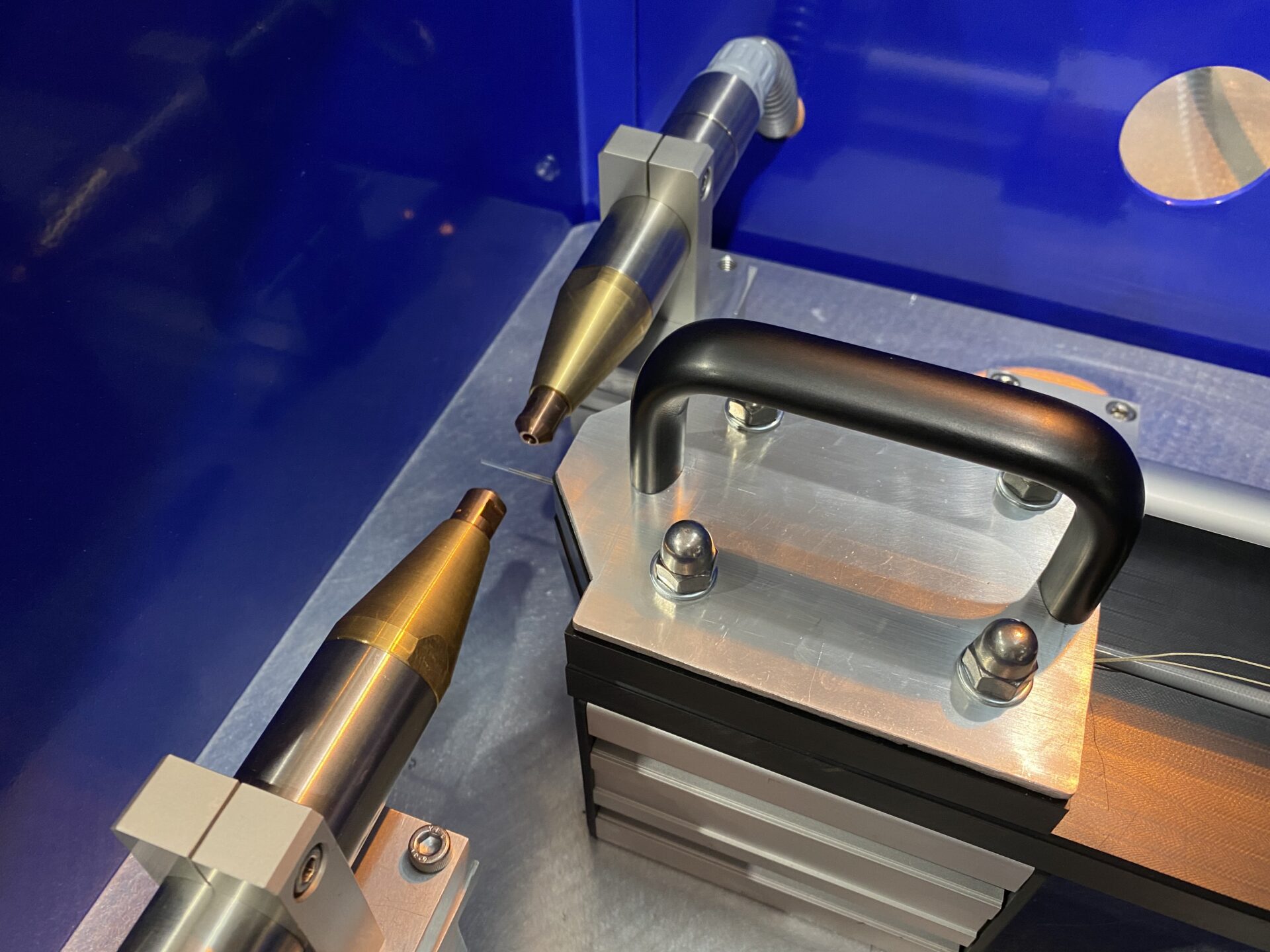
- A Plasma Nozzle is where all the real action happens, the air comes in and through the assembly, whipping around inside the stainless steel nozzle where it is subjected to high voltage power. This rips apart the molecules in the air to create the super energetic plasma which shoots out of the copper coloured tip.
What Atmospheric Plasma Systems Are Available?
The plasma process is similar in all of the systems, but the application of the plasma can vary. For our systems, each machine has at its heart the PlasmaTEC-X generator which is our modular, purpose built fantastic system. This makes understanding different systems quite easy as only the treatment head changes.
Here are some of the common systems available.
Single Nozzle Plasma Treater – PlasmaTEC OEM

A single nozzle system, for simple targeted treatment. Often installed with robotic or other automation, as well as on moving lines like plastic extrusion lines or above a moving rotary table. Available with HMI for easy use and monitoring of on time, process parameters and other important info, or without HMI for full control through either I/O cables or bus control and PLC systems – especially useful if plasma is a small part of a big machine with lots of different systems involved.
Each nozzle will produce between 8mm and 15mm treatment width and be capable of running over 100m/min – this might be as much as 25mm treatment width and over 150m/min in some cases but it’s dependent on the ease of treatment of the material more than the nozzle.
Multi Nozzle Plasma Treater
Running multiple heads together to create an array is a good way to get high speed and performance over a wider treatment width. Systems might have multiple heads to treat a wide flat part, but more often than not the number of heads is to treat some kind of profile or extrusion.
A full system using multiple heads is the ProfileTEC system that has multiple heads that can be moved to point at different areas of the extrusion.
Especially useful for extruded EPDM rubber or other profiled parts, the machine can be changed to meet the next profile in only a few minutes.

Rotating Plasma
Spinning and rotating head plasma treaters are useful for spreading the treatment over a wider area. With this technology you can create a treatment width of up to 150mm wide which would be very costly if done with single nozzles.
This is a great technique for treating wide and flat parts such as sheets or panels and like the single nozzles, the unit can be mounted on to some form of automation or simply placed above a conveyor or a moving part.
The key difference between the individual nozzles and the rotating ones is speed. Due to the spinning nature of the rotating heads, there comes a point when the spinning looks more like a spirograph treatment on the part rather than a consistent full width plasma. So if high speed is the key point, individual nozzles are likely to be the best solution, however if width is important then the rotating nozzles might be the best solution.
There are two key rotating systems; SpinTEC30 is a fixed nozzle 30mm treatment width machine. It’s lightweight head is perfect for robot mounting and the speed achievable is fairly high, usually over 30m/min.
The SpinTEC system is the larger unit with a huge adjustable treatment between 40mm and 150mm, making it the largest single head plasma system available. This larger head is heavier but can still be robot mounted, although it is best used in fixed applications like passing components. The speed at the widest treatment is usually up to around 10m/min.


Custom Atmospheric Plasma Systems
While many customers will buy a plasma treater to install themselves on to an existing line, or for integration by a line builder and automation company, we do offer more complex systems like the ProfileTEC mentioned above. Whether these systems are standalone or designed to wheel in to a line, we can also design this to suit.
Common systems here could by robot or linear drive systems that treat an area using either an array or a robot program to go over areas. Other systems include single spot treatment on parts as well as housings to add for production lines.

ZeroNOx
One common concerns with atmospheric plasma in any form is the creation of nitrous NOx gases; especially when running with multiple nozzles in an enclosed space which will certainly build up above the occupational exposure limit.
There are two solutions:
- Extraction and removal into your own ducting is often the cheapest and easiest way and your extraction company can advise on the suitability of your existing system. We also offer small local extraction systems specific for the nozzles.
- Alternatively, ZeroNOx is a system that filters the air in such a way that it produces only 1% of the gases and keeps any dangers well within the legal limits.

One of the added benefits of ZeroNOx is also a slightly different plasma that on some materials can pack an extra punch and give performance that the standard systems just cannot achieve.
Unique to the market, ZeroNOx is a really special upgrade to the PlasmaTEC family.
SpotTEC
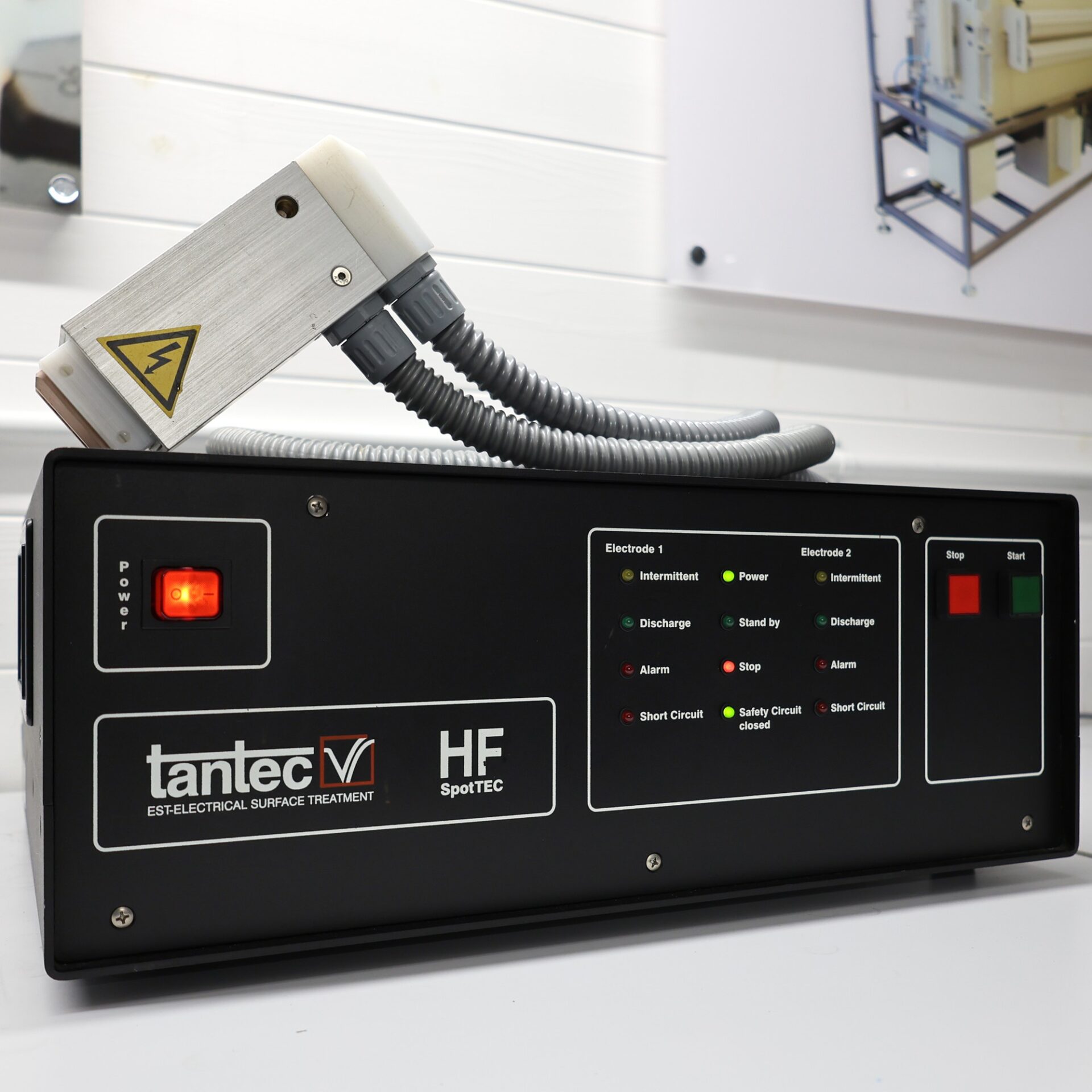
SpotTEC is a machine that falls half under plasma and half under corona. It’s almost a hybrid of the two but offers several key points that plasma systems do not.
The key point is that it is around 30% cheaper and is the starting system we offer. With this you get up to 65mm of treatment with the same kind of nozzle system. It’s offset by the fact that it usually runs in the 15m/min speed range and because it’s a hybrid machine it can only treat polymer materials, not metals. However, for many applications it is brilliant.
Using Atmospheric Plasma – Parameters and Considerations
Atmospheric Plasma Parameters
For most applications, there aren’t too many parameters you need to change. But looking in general at the PlasmaTEC system, here are some that might be considered:
- Air flow – changing air flow can help with plasma consistency, while the wrong airflow can lead to sputtering and other issues. Once set, most systems don’t really change this but it might be changed when servicing is done to adjust for component differences.
- Power – standard power is usually the way to go, it’s where the system is most comfortable and its how you’ll get the most from your machine. A Boost Mode is available to give an extra 1/3rd power which is useful for high speed applications such as robot mounted plasma treating.
- Nozzle tips – there are different nozzle tips, but we usually recommend the standard round nozzle. It’s a great allrounder that performs well in any situation.
- Speed – speed over the part is one of the key parameters. Slower speeds gives more intense treatment with better results, while faster will give less and less dwell time under the nozzle and less treatment. Running low speed on a delicate material likely damage it, but running slow on a greasy metal will allow the heat and power to really clean the material.
- Distance – from the nozzle tip to the material is as important as speed for most applications. Get close and you have more a more powerful treatment, move further back and it’s more gentle. Combining the two, if you run slow and close it is as powerful as it can be, especially with boost on. Moving further back and moving faster will let you treat delicate materials. As a rule of thumb, 10mm from the material surface at 300mm/s is a good place to start testing.
Plasma Treatment Differences
The difference between plasma (and other surface treatments) is often subtle, with atmospheric plasma, corona discharge, vacuum plasma and flame treatment all performing in a similar way. There may be some differences on specific materials, but not often.
In reality, the big difference between the systems is simply choosing the right tool for the job. A thin nozzle isn’t the best choice for a 1m wide board and likewise a wide treater isn’t the right choice for a pipe extrusion line.
Whether using a plasma nozzle, a rotating plasma system, an array of heads or a custom machine, the key considerations are usually line speed, treatment width, part geometry and budget.
Really we assess this on a case by case basis but here’s a quick overview of these points:
- Line speed – single nozzles are by far the most intense and fastest machines, but if your line speed is <10m/min then every machine is open to consider. If you’re line speed is much slower than 10m/min then you might find that a single Plasma Nozzle is actually too intense.
- Treatment width – many projects looking for wider treatment start by looking at the wider treatment systems, which sounds sensible. But they are the more expensive systems to buy and run, so other options such as moving a single nozzle on a robot or some other kind of automation can be a sensible midground.
- Part geometry – single nozzles are round, so they can move easily around a part and get in to small spaces with ease. A wider treater may sound sensible, but if you have any geometry to the part, it’ll be hard to keep the head perfectly positioned across the part at all times. If the part is flat then a wider treater will be really sensible as one wider treater is significantly cheaper than many individual nozzles.
- Budget – as eluded to above, there certainly are price differences between systems and indeed between technologies. Plasma nozzles, Plasma Wide Treaters and Spinning Plasma are all great techniques, but actually corona treatment or vacuum plasma might be sensible in many applications too. Having your own budget in mind is often a really key question when we come to looking at the different solutions to a problem.
Atmospheric Plasma Health and Safety
Plasma is an energetic gas, and looking around us we find plasma in many applications from plasma televisions, halogen lights such as neon signs and of course flames are a form of plasma.
With a Plasma jet like this, we have three key safety considerations:
- Temperature – Plasma is often at least 150C and often exceeds 200C. This is hot to hold in one place, but actually will only impart maximum 5 degrees when moving at the right speed over a part. Stopped lines, people getting close to the heads and delicate materials do need to consider temperature though.
- High voltage – within the Plasma Nozzle we have high voltage, and while the plasma coming out is potential free and you could touch it, the plasma nozzle is exposed. Inserting a screw driver in to the open end of the nozzle would not be safe. Using plasma on conductive materials isn’t a problem and is routinely a treatment for circuit boards and metals without any problems.
- Nitrous gases – as mentioned in the discussion about ZeroNOx, there will be gases given off from plasma and if left in an enclosed space without extraction would likely get above a safe working limit. Knowledge of this allows you to design extraction and test for the gases to ensure safety. Many machines are deemed safe when they run for small periods in open spaces, such as robot mounted plasma treatment alongside a glue dispensing system.
Atmospheric Plasma Running Costs
Running costs vary from the single nozzles to the larger, wider plasma systems. But each head will usually run around 450w and need around 30L/min of compressed air. Usually no other gases are needed or other consumables in the day to day operation.
Servicing is usually recommended once per year/ shift. This might not be at the limit of the consumables for systems running short treatment compared with those running non-stop on an extrusion line but a sanity check and general check up is sensible to keep the units work at their best.
Typically a service will cost anywhere from £200 parts only to typically £1,500 full on site check and service, depending on distance, training requirement and number of nozzles.
For more information, read our running costs blog here!
Atmospheric Plasma Uses and Industries
Using plasma nozzles in manufacturing is common across a wide range of industries. Some of the common applications are:
- Extrusion line treatment of pipes, cables and profiles, which could be to improve adhesion of printing ink on pipes and cables, adhesion of slip coatings or flock on rubber profiles, or adhesion of liquid foams or skins on to plastic profiles. These extrusions are common for pipe and cable and could find themselves in automotive components, aerospace, general construction and motorsport. Extrusion lines for various rubber profiles is very common in automotive but also for construction materials such as door seals.
- Robot mounted plasma nozzles are often a cheap and easy way to work on a material, especially if the robot is already in use. This works really well when glue dispensing robots can be combined with atmospheric plasma. The treatment can be run first quickly, followed by the glue being dispensed immediately after. Really good for sealing and bonding applications and often easy to integrate in to full automation cells. Very common for automotive parts as well as medical device manufacturers.
- Mounted heads over moving production has similar advantages to extrusion lines, as the plasma heads can simply bolt on and treat a part as it passes by. No additional processing steps or space required other than enough to fit a small nozzle. This is especially good for treating needle hubs for example in medical device manufacturing, or prior to printing gift and credit card personalisation. Deploying a plasma nozzle immediately before print or coating is really smart.
In each of these applications we are usually looking to improve adhesion of something, most commonly a coating, printing inks, glues and sealants or a tape. We usually refer to this as plasma treating, but actually there is also a high degree of plasma cleaning done in the first place on some materials. Plasma treatment can only occur on the clean material surface, so cleaning must take place first to get to the bare material. It’s not easy to spot the difference here so it’s easy to think that both happen on most materials.
Other Atmospheric Plasma Considerations
When a customer approaches us with a problem, atmospheric plasma is often high on the list of solutions for many. But it isn’t the only solution and while it’s easy to get the idea of these simple systems in mind, other solutions like Vacuum Plasma and Corona Treatment are worth looking at too.
We look at each material as if it’s never been seen before because in a way, it hasn’t. The material supplier, manufacturing process to make, the age of the material and the storage and handling conditions can all play a big part in the quality of the part we’re evaluating. With this in mind, questions like ‘how long does plasma treatment last?’ and ‘which is better, plasma or corona?’ are often impossible to answer without working on the problem.
In general, plasma treatment lasts minutes to days on oily materials, days to weeks on metals and flexible, but clean materials, and then weeks to months on clean, rigid materials. Would you see any difference in this theory between plasma and corona? Often no, but sometimes it can be very different.
When working with Tantec UK, we offer full lab support and testing so we can put answers to these considerations and others to make sure you get an answer that’s right for you, your process and your material rather than an outdated text book response that doesn’t work for industrial applications.
Conclusion
Atmospheric Plasma is a really versatile and powerful tool for many applications and finds its way in to lots of industries, treating a wide range of materials and solving a number of problems. It’s usually a sensible cost and the additional process requirements are low as it bolts on to existing lines really well.
Tantec UK are happy to offer atmospheric plasma trials, rental systems which are available to book through our shop site Ebble.shop and contract treatment which has more information here.


