


Table of Contents
Costs For Running Plasma and Corona Systems In 2025
Plasma and corona systems are usually a green and cost effective way of pre-treating a material surface to improve adhesion. This might be in the medical sector where safety critical print is being adhered to a polymer syringe, or automotive where foam and leather is being bonded onto a moulded plastic interior part.
One of the main concerns people new to these technologies have is the running costs, especially as many system use high voltage which can sound expensive.
The main two consumable costs for any machine utilising this technology will be power and compressed air.
Ongoing maintenance, servicing and consumables are also a consideration and some examples are given for this too.
It is worth pointing out that all of our systems are chemical free and don’t need continuously fed consumables aside from air and power. There’s no additional hidden costs and there’s no need to store drums or boxes of anything to make the systems work.

We will take a look at running costs for Vacuum Plasma, Atmospheric Plasma and Corona systems to give you an understanding of what you’re getting involved with.
References to power costs are taken from U Switch for Business and a typical price per kWh of 27.5p was accurate as of August 2026.
Atmospheric Plasma
Atmospheric plasma is a relatively easy to install and run system, usually either placed over a moving product like an extrusion line for pipes, cables or profiles, or run with automation like a robot mounted system.
The main consumables for this equipment are power and compressed air, with a typical single head unit being used for calculations. Mutltiple head systems will be multiples of this and the rotating head systems will be similar with a little extra power needed for motors and controls.
In addition to the systems themselves there are usually two main add ons that could be used – ZeroNOxTEC which is a system capable of creating a specific gas mixture that reduces NOx gases created by the process. This runs at a similar cost to the main unit.
The second addon would be extraction which may be used alongside a ZeroNOxTEC in very high use cases, but generally would be used instead of and again would be similar power to a single nozzle. Because these gases aren’t always highly present, it might not be essential for either of these addons.
Consumables – Power
SpotTEC and PlasmaTEC are nozzle-type devices that are usually used mounted on robots or a moving arm like an XY table They can be also be static above a moving line like a rail attached to a bowl feeder or an extrusion line.

When used at full power both PlasmaTEC and SpotTEC run at around 500w per head.
For a typical 8-hour production day, this will mean a maximum of 4kWh of power usage that would be seen on a continuous extrusion line but would likely be much lower, possibly less than 1kWh for use on a robot where loading, robot movement, and other activities take up some of the cycle time.
This power use would cost between £0.25 and £1.10 per 8-hour shift, per nozzle.
Consumables – Compressed Air
SpotTEC houses its own air supply, so there aren’t any additional compressed air costs.
PlasmaTEC requires around 30L/min per nozzle of compressed air. How this is generated can vary costing – for an industrial compressor, this won’t be significant and will only be a small portion of the running costs. Running on a standalone compressor is likely around 500w, so the compressor power consumption should be similar or less than the machines themselves.
Atmospheric Plasma Wearing Parts and Servicing
It is generally good practice to perform preventative maintenance at least once per year, if running multiple shifts then you might want to increase this depending on actual run time. A single 8-hour shift should require just one service, but a monthly or bi-annual visual check would be sensible to catch anything that might develop such as damage to cables from rubbing or stretching.
Common consumable parts for nozzle systems are wearing electrodes which can be changed by your engineering team or as part of a service contract.
For single-head servicing, it is likely to cost £115 to £300 per nozzle for parts only and £300 to £1,500 for an engineer visit, depending on the travel distance and the number of heads.
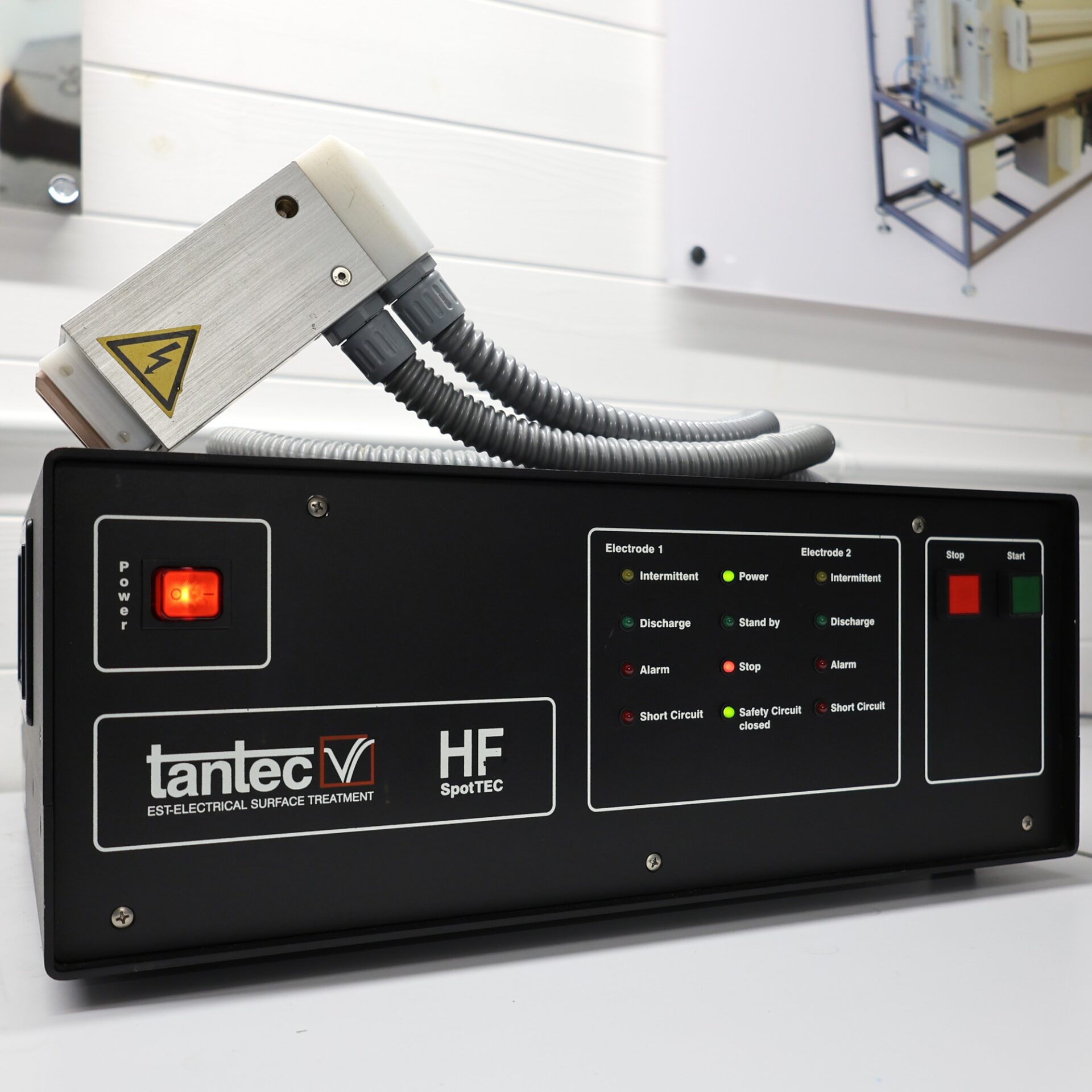
Holding you own spare parts is recommended, especially for high-uptime systems. However, we carry a comprehensive level of stock parts and rental systems from our UK site for urgent problems. You can book rental systems online at Ebble.Shop or get in touch with the service team.
Vacuum Plasma
Vacuum plasma is an enclosed system that has very few moving parts or extras needed for it to run effectively so running costs are fairly clear. Because everything occurs within a sealed chamber it also means that we have high control over any risks so unlike other technologies we have no need for specific gases or extraction – although there are some high end systems that may require this, these are much less common.
Consumables – Power
Vacuum plasma chambers generally run at less than 2kW for the main treatment machine, but they can require large, and powerful vacuum pumps. The size of the system and the speed of the process will guide the specific model of machine and associated pump, also the amount of time the process is actually running makes a difference.
Atypical system running for a full 8 hour shift will have the machine running full power around 60% of the time.
As a quick guide using this information:
| Machine Size | Pump and Machine Power | 8 Hour Typical Costs (@60%) |
|---|---|---|
| Small (VacuLAB and VacuTEC 2020) | 1kW to 2.5kW | £1.30 to £3.30 |
| Medium (VacuTEC 5050 and VacuTEC 8080) | 7.5kW to 9.5kW | £9.90 to £12.54 |
| Large (VacuTEC 100100) | 17kW to 20kW | £22.44 to £26.40 |
| Extra Large (custom built with multiple pumps) | 20kW to 30kW | £26.40 to £39.60 |
Using a lower power or a smaller pump can save a lot over the year on larger systems, but the larger systems can treat several parts in a single run and quickly leading to a more efficient process.
Consumables – Compressed Air and Gases
Compressed air is used on most systems but only for system pneumatics so the requirement is very low, only pennies per day.
Process gases are rarely needed but those looking for something specific might use two or three cylinder of oxygen for example over a year. Including cylinder rental and gas use this might be between £250 and £500 for the year.

Vacuum Plasma Wearing Parts and Servicing
The main chamber and system have very few consumable parts, the door seal which will degrade over time, filters for air inlets and minor other parts on certain systems. The vacuum pumps require servicing and this is usually recommended once per year per shift.
This servicing mainly includes fresh oil and filters to keep it running efficiently and avoiding damage from poor quality, degraded oil. This ranges from £250 for smaller systems to £2,000 for larger systems, possibly more with travel/ shipping and engineering time.
Corona Treatment
Corona discharge systems, also known as corona treaters and dielectric barrier discharge systems come in a wide variety of shapes and sizes so running costs can vary quite a bit, however each system has a similar set of modular components so we can make some general assumptions.
Unlike Atmospheric Plasma that produces NOx in lower concentrations on short runs, Corona produces high quanitites of Ozone immediately and must be run with extraction so these costs are considered as part of running.
The positive is that ozone is well understood and easily removed and filtered, it can be easily monitored and is one of the most defined biproducts of any industrial process which allows us to create 100% safe working encironments – you can read more at the UK Government website.
Consumables – Power
Corona treaters generally only use power, though some may use very small amounts of compressed air. A secondary requirement of corona treaters is to extract or filter ozone on all systems.

Power required for most corona treaters is usually no more than 2kW when treating, but can be as little as 200w for smaller systems. The extraction consists of an extraction fan which will likely run around 300w so total systems range from 500w systems up to 2.5kW in most cases.
This means a typical system running for the a full 8 hour shift will use between £1.10 and £5.50 per day.
Corona Wearing Parts and Servicing
Many corona treatment systems only require cleaning as their main service, needing to be kept free of dust and debris with a weekly or monthly clean down depending on the environment.
Extraction systems will require a recharge service; often suggested to be performed once per year, per shift, although this can depend on the system. Those services can be offered on-site or return to base usually for £400 – £1,000 depending on the size of the filtration unit.
Other Costs and Considerations
Spare Parts
Components on all Tantec equipment are robust industrial specification parts that are designed to last unless designated as consumables.
That being said, we often see customers have concerns with parts that become cracked or broken such as electrodes for vacuum plasma and corona treatment systems. These electrodes are strong and only break when mishandled but especially for custom systems could be 2+ week lead time items so holding stock of these critical parts might be a serious consideration.
Nozzle systems on moving automation such as robotics can often get snagged if cable and pipe handling looms aren’t installed well and while these parts are normally in stock at all times, there could be a day or two with shipping and it can certainly be a big repair bill if the full assembly is damaged. Well designed cable looms and support systems are key here but a spare nozzle might be sensible if downtime is unacceptable.
Machine misuse and incorrect servicing due to lack of onsite engineer training has been an issue before and we are more than happy to offer Tantec trained engineers to come onsite to perform the service or offer training to your team for you to do the work inhouse. Most systems are simple enough to service and just need the right knowledge to do it.

Extraction and LEV
It is a mandatory law in the UK to have local extraction and ventilation (LEV) checked once every 14 month period to ensure it is working safely. For all systems that are connected with some form of extraction a service for recharging and checking their effectiveness is crucial.
You may already have LEV testing onsite for which adding a new small system will have negligible costs, equally if you’re already taking a service with us it will be a relatively low cost addition.
On Going Support
It’s also worth mentioning the subcontract treatment side of the business at times like this because it is there to offer support for treatment of parts for one off projects, overflow support or breakdown support. Ebble Manufacturing offer this contract treatment from the Redditch factory and parts can often be booked in quickly for a speedy turn around.
This is most frequently used for standalone projects or for early days ahead of buying equipment, but it’s also there for overflow manufacturing and to support in times of machine breakdown or problems onsite.
There could also be some ongoing training costs such as operator or maintenance costs but most of our systems are fairly simlpe once the initial training has been given so internal training between colleagues with the odd question on a service visit is generally more than enough.


